


Intraocular Lenses (IOLs)
What is an IOL and How Does it Work?
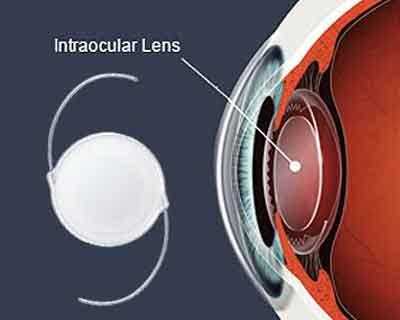
An IOL replaces your natural lens that contains the cataract. An IOL focuses light that comes into your eyes through the cornea and pupil onto the retina–the sensitive tissue at the back of the eye that relays images through the optic nerve to the brain. Most IOLs are made of a flexible, foldable material and are about one-third of the size of a dime. There are different types of IOLs that serve different functions for the eyes.
What are the Different Types of IOLs Available?
The type of IOL implanted will affect how you see when you are not wearing eyeglasses. Glasses may still be needed by some people for some activities. In certain cases, cost may be a deciding factor for you if you have the option of selecting special premium IOLs that may reduce your dependency on glasses.
The following are the different types of IOLs that are available:
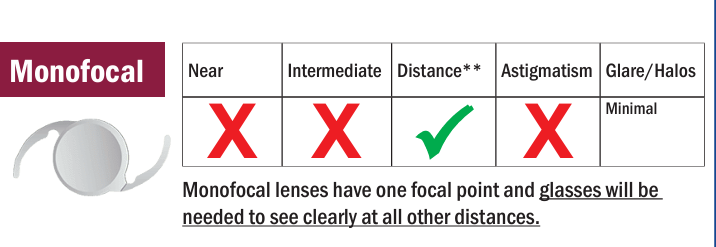
These lenses have one point of focus and can usually give you clear distance vision. However, while distance vision is improved, most patients still need to wear glasses for certain tasks, such as reading or working at the computer, even if they didn’t wear glasses for reading prior to surgery. And, if you have corneal astigmatism, you may still need to wear glasses for distance vision as well. Medicare and most commercial insurance carriers will pay for the cataract surgery and the cost of this implant.
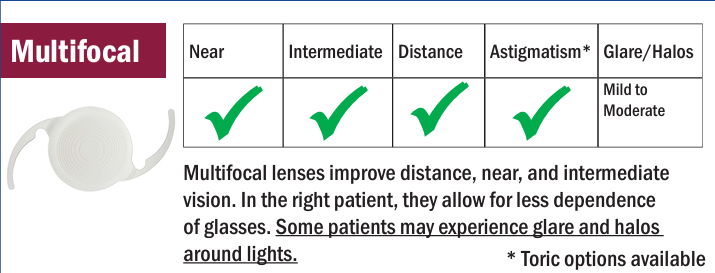
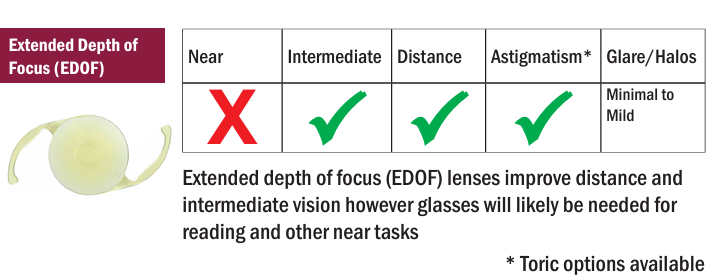
These lenses are designed to replace cataracts and correct presbyopia at the same time. Their goal is to give you an extended range of vision, from near to far, and in between. This lens implant does not guarantee that you will be completely free from wearing glasses, but it does have the potential to limit your dependence on glasses. These lenses can cause halos around headlights and streetlights, which typically become less frequent with the passage of time. Medicare and commercial insurance carriers will pay the cost of the surgery, but the cost of the lens is not covered and will need to be paid out of pocket.
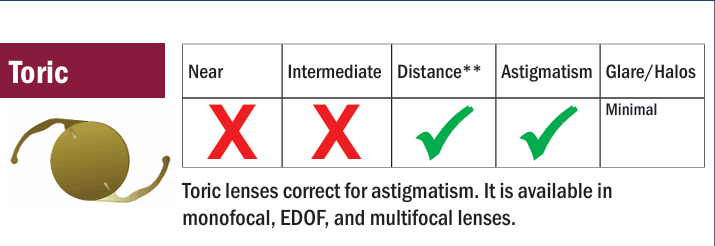
For patients with corneal astigmatism. These lenses usually give patients quality distance vision with less dependence on glasses. However, most patients will still need to wear glasses for tasks such as reading or working at the computer. Medicare and commercial insurance carriers will pay the cost of the surgery, but the cost of the lens is not covered and will need to be paid out of pocket.
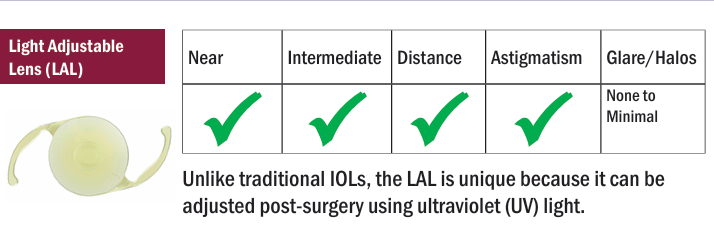
Light Adjustable Lenses (LALs) are an innovative and trusted technology developed over the past decade. Unlike traditional intraocular lenses (IOLs), where your surgeon must determine the lens power before surgery based on measurements and calculations, LALs provide the unique ability to fine-tune your vision after surgery. This allows you and your surgeon to work together postoperatively to customize the lens power and optimize your visual outcome based on your individual needs and preferences.
Scan the QR code below to learn more about the differences between fixed-power lenses–Monofocal, EDOF, Multifocal, and Toric IOLs–and adjustable lenses.

Choosing the IOL that is Best for You
At OCB, you and your family will be supported every step of the way throughout your cataract surgery journey. The process below is designed to help you make an informed and confident decision about your lens choice:
- Schedule your cataract consultation today!
- Arrive for your earliest scheduled appointment on the day of your consultation.
- Before meeting with your surgeon, you will undergo a series of specialized tests. These evaluations provide important measurements and information that help determine which intraocular lens (IOL) options are best suited for your eyes and visual needs.
- Meet with your surgeon to review your lens options.
- Your surgeon will discuss the IOLs for which you are a candidate, explain the benefits of each option, and review associated costs and insurance coverage.
- Choose the lens that best fits your lifestyle and vision goals.
- With guidance from your care team, you will make an informed decision about the lens option that aligns best with your individual needs and expectations by the end of your consultation!

